
Smart coolers and grab-and-go fridges
One cabinet is one temperature, and that decides your assortment. Chilled, frozen and ambient compared, and why a cooler sells food a vending machine cannot.
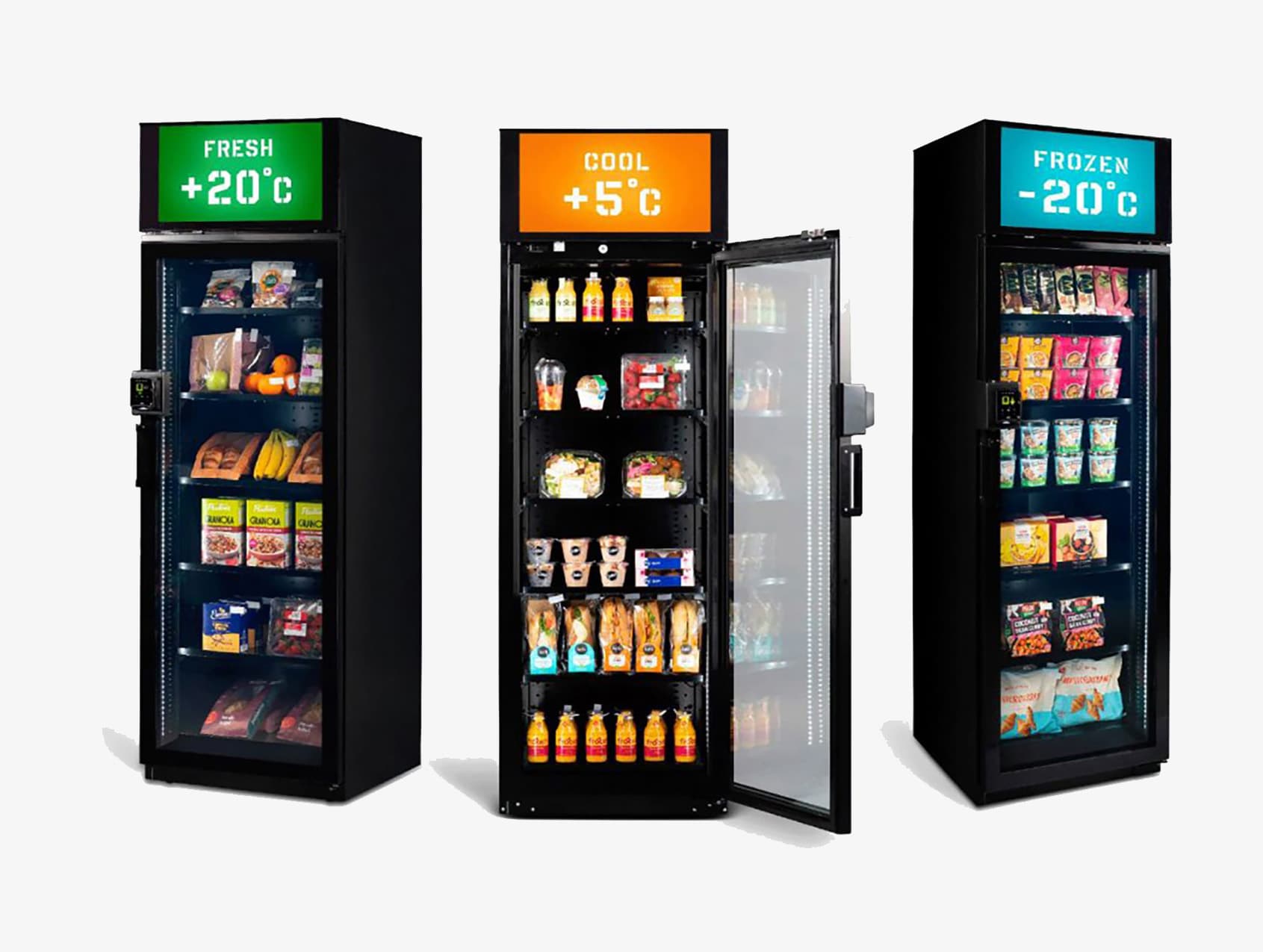
A smart cooler is a locked refrigerated cabinet that identifies what a customer takes and charges for it without a checkout. The same thing is sold as a grab-and-go fridge, a vending fridge or a smart fridge, and the naming does not matter much. What matters is a constraint that almost no product page states plainly: one cabinet holds one temperature, and that single fact decides your assortment before you choose anything else.
One cabinet is one temperature
This is the question that surprises buyers late in the process. A cooler is not a box with a dial that covers every product; it holds one temperature band. Salad and ice cream are both cold, but they are differently cold, and they cannot share a unit. If a location needs both, that is two cabinets — two installs, two power draws, two footprints.
Chilled, roughly +2 to +6 °C
Ready meals, salads, sandwiches, yoghurt, smoothies, juices, drinks served cold.
Frozen, roughly −18 °C and below
Ice cream, frozen meals, frozen snacks.
Ambient, roughly +20 to +30 °C
Fruit, nuts, bars, bottled drinks that need no chilling — and non-food items, since a smart cabinet is not limited to food.
The practical consequence is that the right question is never "which cooler". It is "what am I selling, and how many cabinets does that assortment require". Answering it in that order avoids the common outcome: a unit arrives and the assortment gets trimmed to fit it.
Why can a smart cooler sell fresh food?
A traditional machine dispenses: the product falls. A smart cooler does not — the door opens, the item is taken by hand, the door closes and the charge is built from what left. That mechanical difference is the entire reason fresh food is possible. A sandwich, a bowl of salad, a yoghurt or a soft pack survives being picked up and does not survive being dropped.
It also changes what the customer experiences. They are not selecting from a keypad and hoping; they are looking at the shelf and picking, the way they would in a shop. For fresh food that matters, because appearance is most of the purchase decision.
Chilled and frozen behave differently as a business
The hardest part of a chilled cabinet is the date. Fresh products expire in days, so an assortment that does not move becomes waste rather than stock. This is where knowing expiry per item rather than per product type earns its keep: a discount as the date approaches is the only lever that actually works, and it only works if the cabinet knows which individual item is close to its date.
Frozen is more forgiving in exactly that respect — shelf life runs in months, so a quiet week does not turn into loss. Its failure mode is elsewhere and it is sharper: the cold chain does not tolerate a gap. An item that thaws during restocking and refreezes in the cabinet looks perfect on the shelf. So with frozen, the decisive factor is not the cabinet but how product gets from the freezer into it, and how long it spends in between.
For reference on where the boundaries sit, the Finnish Food Authority calls the range between +6 and +60 °C the danger zone, because harmful microbes multiply there. That is the Finnish authority's framing and it is worth knowing, but the binding requirements in your market come from your own food authority, not from us.
Where do smart coolers work?
- Places with a fixed population and no canteen: offices, factories, data centres, logistics sites.
- Places open longer than they are staffed: 24-hour gyms, hotels after the restaurant closes, hospitals on night shift.
- Places where people are already standing still: lobbies, waiting areas, break rooms, next to a lift.
- Places too small for a shop but too regular to ignore — which is most of the demand this category serves.
It works badly where people pass through quickly without eating on site, and where the assortment would have to be wide to satisfy anyone. A small, fast-turning range always looks full; a wide one looks half-empty on the same sales.