
Office vending machines
Lunch is the whole business: which temperature, how many cabinets, where to put them, and what shift work changes. Written from running the routes.
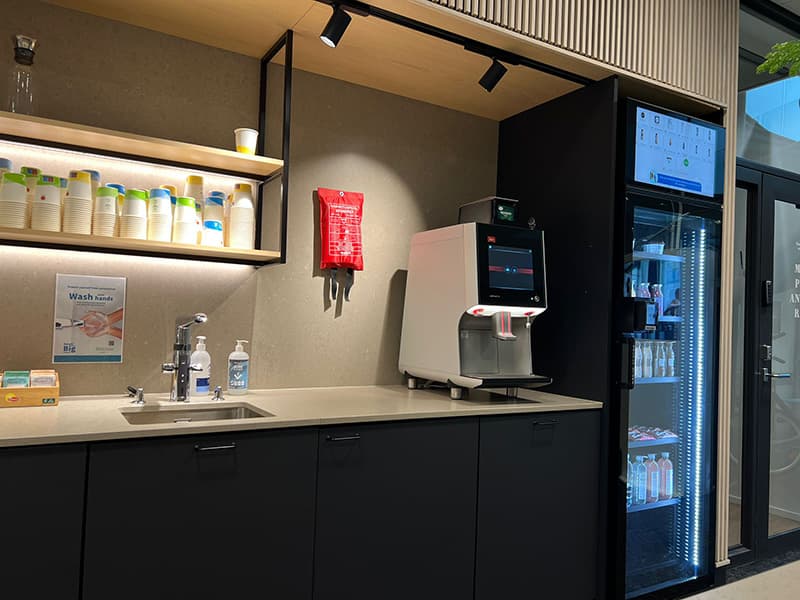
An office is the most predictable location in unattended retail, and that is exactly why it is the one people get wrong. The population is fixed, the demand peaks at a known hour and nobody is discovering the place by accident. So the question is not whether a cabinet will sell — it is how many cabinets, holding what, and how often somebody has to drive there. This page answers those three.
Lunch is the whole business
In an office the demand that matters is a meal, not a snack. That single fact decides almost everything downstream, because a location selling lunch carries a basket several times larger than one selling a bar and a bottle of water. Selfly's published fleet averages for 2024 put the average basket at about 4.82 EUR across its installed base; village-shop style locations sit closer to two. An office sits at the upper end, and it gets there through salads, sandwiches and ready meals — not through range.
Which means the cabinet has to be chilled, roughly +2 to +6 °C. Ambient is the wrong choice for a first office cabinet even though it is cheaper to run: it cannot hold the product that makes the basket.
The secondary peak is mid-afternoon and it is a snack, not a meal. It is real but it is small, and it does not justify a second cabinet on its own. Put those items on a shelf inside the chilled unit first and see whether the demand is there before adding hardware.
Where should the cabinet go in an office?
People in an office walk the same route several times a day: entrance, lift, coffee point, their desk. A cabinet on that route sells. The same cabinet in the far corner of the break room does not, because nobody detours for a sandwich — they leave the building instead, and once they have left they are gone for the whole hour.
The coffee point is the strongest position in most offices, and the reason is behavioural rather than commercial: people go there anyway, several times a day, and they are already standing still. Next to the lift is second. A dedicated corner nobody passes is worse than no cabinet, because it also convinces the customer that unattended retail does not work.
Does an office need one cabinet or two?
Start with one, in almost every case, including in large offices. The first month tells you more than any estimate: whether the cabinet empties before the day ends, at what hour, and on which products. Buying two up front usually means buying the wrong second one.
The signals that genuinely call for a second unit are specific, and only the first two are about volume:
- The cabinet is empty before the lunch peak ends — you are losing the highest-basket hour, every day.
- Restocking has to happen more than the route can absorb, which is a cost problem rather than a demand problem.
- The site wants a second temperature — frozen or ambient — which is not a capacity question at all. One cabinet is one temperature.
- The building has floors that do not mix. Nobody walks two floors for a sandwich, so two small cabinets on two floors usually beat one large one in the lobby.
Shift work changes the arithmetic
A factory or a data centre is not a nine-to-five office, and the difference is not the number of people — it is that demand thins out but never stops. A night shift has no canteen, no shop and often no town nearby, so the cabinet is not a convenience there, it is the only option. In practice this makes shift sites more attractive than their headcount suggests: fewer people, but a much higher share of them buy.
It also changes restocking. A site that runs around the clock has no quiet window you can rely on, so the visit has to fit the shift pattern rather than the working day.
Who pays, and who carries the obligations
There are two models and they are different businesses, not two prices. In the service model the office pays no monthly fee: products, restocking, date monitoring and maintenance are ours, and so is the margin. If the office buys or rents the cabinet and fills it itself, it keeps the margin — and takes on the work and the obligations that come with selling food, including being the food business operator under its own country's rules.
That second point is the one worth settling in writing before anything is installed, because it is easy to assume and expensive to discover. We can describe how it works in Finland; the binding answer for your site comes from your own food authority.
The line that gets left out of both models is electricity. A chilled cabinet runs continuously and the cost lands on the building's bill, not the supplier's invoice. It is not large, but a comparison between two offers is not a comparison if one of them quietly excludes it.